
How to Check Criminal History in Livermore
A Livermore search works best when the requested item is named first. An incident report explains what an officer recorded. A booking file shows custody. A court docket shows charges and rulings. A KSP self-review covers the subject’s centralized Kentucky criminal history, but it is not a public name-search portal. Those records can describe the same event while remaining in separate offices.
- Call Livermore City Hall to ask whether the city created or retained the specific record, and confirm whether the sheriff or KSP responded.
- Request the incident or arrest report from that responding agency, using the event date, precise place, incident number, and desired format.
- Call the McLean Circuit Court Clerk for the District or Circuit Court docket, filed charges, orders, and final disposition.
- For custody, call dispatch or the county jailer to identify the neighboring detention center, then check that facility’s booking record.
- Use KSP self-review, AOC court-history channels, KOOL, or VINE only for the separate statewide purpose each system serves.
The sequence prevents a common error: asking one custodian for a file created by another. The broader McLean County criminal history overview explains the statewide layers in more depth.
Livermore Records at Two Rivers
Livermore sits where the Green and Rough Rivers meet. The U.S. 431 bridge illustrates why jurisdiction should be confirmed before a request is sent. Official county material describes a route that begins in McLean County, crosses the Rough River, touches a sliver of Ohio County, crosses the Green River, and returns to McLean. A short trip can therefore involve more than one county’s officers or detention system.
This geography is not proof that an outside agency handled any given Livermore event. It is a reason to preserve the exact address, direction of travel, time, and agency name from a citation or release. Those details tell the sheriff, KSP, or clerk which file to locate. They also help explain why a Livermore arrest record and its booking entry may bear different county names.
The Livermore Police Department
The current GRADD Livermore officials listing shows Police Chief as N/A. No current stand-alone Livermore police records form, arrest blotter, crime map, police app, or case-search portal was found. Older directory references should not be treated as proof of an active department. The official City of Livermore site is the city contact starting point. City Hall, at 105 West Third Street, can answer the first custody question, but it should not be described as a police records portal.
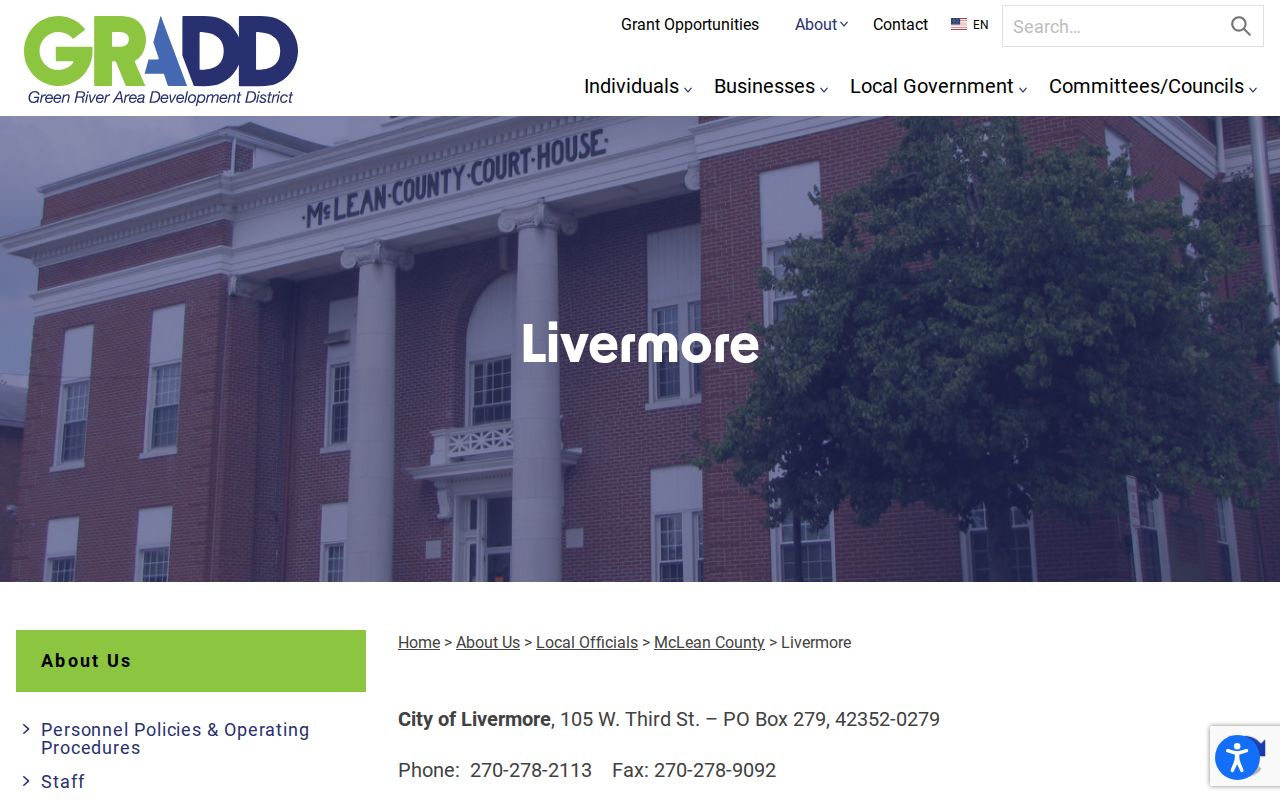
The officials listing supports the correct Livermore routing rule: identify who responded instead of inventing a city police desk. If the McLean Sheriff created the report, call (270) 273-3276. If KSP Post 16 created it, use KSP Open Records. City Hall should receive only a request for a record the city actually holds.
Requesting Livermore Incident Records
Begin with a simple custody test: did Livermore City create or retain the record, or did the sheriff or KSP create it? If City Hall confirms city custody, submit a narrow Kentucky Open Records Act request to the current city custodian. Include the requester’s name and address, any current residency statement the form requires, the date range, location, incident number if known, record type, and electronic or paper preference.
No official Livermore city criminal-record request form, email-only police portal, posted police fee, or special turnaround rule was found. Ask for the present submission method and copy cost before ordering. A sheriff request goes to the sheriff’s custodian. A KSP request should identify Livermore, McLean County, the address, date, and event. KSP publishes a per-page charge for released paper records and separate media charges, but that schedule does not set Livermore City Hall or court copy prices.
Note: A request should describe an existing record precisely; it should not ask City Hall to research a person or interpret a court charge.
Arrests and Bookings in Livermore
Livermore has no confirmed municipal lockup, and McLean County has no confirmed detention center or online local jail roster. An officer may take an arrestee to a contracted facility in Ohio, Muhlenberg, or Daviess County. Call McLean dispatch at (270) 273-3551 or the jailer at (270) 499-8530 to identify the receiving facility before searching. A blank McLean roster is not proof that no arrest occurred.
The October 27, 2024 KSP release concerning a Livermore event demonstrates the split. The reported event led to an intercounty pursuit and lodging in the Ohio County Detention Center.

The release is a lead, not a full Livermore criminal history. The KSP investigative report, Ohio County booking record, McLean court docket, and final judgment remain distinct. Kentucky VINE can add custody-change notices after the correct facility is known, but it does not provide the officer narrative or case disposition.
Livermore Crime Data Limits
A current city violent-crime or property-crime rate cannot be supported from a stand-alone Livermore reporting police agency. The official listing does not show a police chief, and sheriff incidents cannot simply be assigned to city boundaries. KSP’s Crime in Kentucky tables and FBI Crime Data Explorer figures are organized around reporting agencies, not a custom Livermore geographic count.
No Livermore row, or a zero shown for an agency, does not establish that no crime occurred in the city. For a specific person or incident, use the responding agency’s report and the court file. For a county trend, label the figure as countywide or agency-based. That distinction keeps Livermore criminal record claims tied to what the source can actually prove.
Livermore Municipal Court Records
Livermore has no municipal court. Kentucky’s unified court system replaced those local tribunals. McLean District Court hears misdemeanors, violations, traffic matters, felony preliminary stages, and criminal-penalty city ordinance cases. Circuit Court handles felony prosecutions after the proper charging path. The Office of Circuit Court Clerk at 210 East Main Street in Calhoun maintains the official case records.
| Court Name | No Livermore municipal court; use McLean District Court or Circuit Court. |
|---|---|
| Case Types Heard | District Court hears misdemeanors, violations, traffic, ordinance crimes, and felony preliminary matters; Circuit Court hears felonies. |
| Case Lookup Channel | Call or visit the McLean Circuit Court Clerk and provide the defendant name, approximate year, and case number if known. |
| What the Docket Shows | Filed charges, hearing entries, orders, pleas, disposition, and sentence where applicable. |
| Copies & Fees | Ask the clerk for current search, plain-copy, and certified-copy charges before ordering. |
Calling the clerk at (270) 273-3966 or (270) 273-5055 is more reliable than asking City Hall to interpret a criminal case. The McLean criminal court case records route also covers older files and official copy requests.
Historic Livermore Criminal Records
Modern portals are not the best starting point for an old Livermore prosecution. Official local history notes the post-Civil War Fields Hotel, the 1937 flood and Red Cross boats, a mail boat known for three horn blasts, and Hackett Cemetery burials linked to both Civil War sides. The city library occupies a circa-1880 National Register building and holds local art and early Livermore displays. These sources provide context, not criminal dockets.
For genealogy or historical case research, begin with the McLean clerk. Give names, a date span, suspected charge, and any court term or file reference. Ask whether the record is paper, microfilm, or off-site and request the record-facility and locator numbers when needed. The Kentucky Department for Libraries and Archives inventory can help identify historic court holdings, but an archive cannot be searched from a modern city contact page.
Where Livermore Records End Up
A Livermore event can create an agency report, a neighboring-county custody file, a McLean court case, and a centralized criminal-history entry. The court disposition should return to the state repository so it can be matched to the arrest cycle. Delays, old paper files, missing identifiers, or a booking held elsewhere can leave gaps between these systems.
Record flow: McLean Sheriff or KSP › McLean County Courts › Kentucky State Police Criminal Identification and Records Branch
Recent activity is most likely to be clear at dispatch, the responding agency, and the receiving detention center. Filed charges and final results belong to the clerk. A person reviewing their own statewide record can use KSP’s authorized self-review path. CourtNet information does not become a fingerprint-based KSP rap sheet, and a jail entry does not establish guilt.
Following Livermore Records Across Counties
When a Livermore record names another county, compare the role each location played. McLean may be the arrest scene and court venue. Ohio County may hold the booking because its detention center received the person. KSP may hold the investigative report because a trooper handled the case. Each office can release only the record it maintains and may apply its own access and redaction rules.
Write down the booking number, case number, incident number, and full name as each office supplies them. These identifiers join the record trail without treating one source as the whole history. If a disposition seems absent from a KSP self-review, obtain the signed McLean order and follow the official correction route rather than relying on an old release.
Public Access Rules
Executive-agency reports and judicial case files use different access tracks. The Kentucky Open Records Act governs requests to City Hall, the sheriff, and KSP. Court documents are obtained through the Office of Circuit Court Clerk and Kentucky Court of Justice procedures. Juvenile material, sealed or expunged cases, grand-jury information, protected victim details, and sensitive personal data may be closed or redacted. Active-investigation concerns require a statute-based explanation, not a permanent blanket refusal.
Key Statutes:
Kentucky Open Records Act, KRS 61.870-.884 - defines public records, sets inspection and response procedures, and recognizes specific exemptions.
KRS 17.150 - governs access and dissemination for law-enforcement records, including completed investigations and segregable material.
KRS 17.185 - authorizes KSP name-based and fingerprint-supported criminal-history checks for the subject under the official process.
When an executive agency denies access, its response should cite the exemption and explain how it applies. Kentucky’s Attorney General review path may be available under KRS 61.880. Court-record questions instead stay within judicial access procedures.
Livermore Record Request Fields
A concise request saves time because Livermore has no one-stop criminal-record portal. Keep the description limited to records that likely exist and direct it to the creator.
| Record holder | Useful fields | Access route |
|---|---|---|
| Livermore City | Date range, city record type, subject, preferred format | Call City Hall for the current custodian and method |
| McLean Sheriff or KSP | Incident number, date, time, place, agency, media type | Agency-specific open-record request |
| McLean courts | Defendant name, case number, year, court, requested order | Circuit Clerk phone or counter |
| Receiving jail | Name and booking number if known | Identify facility through dispatch or jailer first |
Ask for current fees and available formats before ordering. Keep the agency’s response with the resulting record so later searches can show what was requested, what was withheld, and which office supplied it.
For Livermore video, audio, photographs, or dispatch material, state a narrow time range and ask whether retention could affect access. If the office refers the request elsewhere, record the custodian’s name and the reason. That small step helps preserve the Livermore record trail when a single event crosses city, county, and state systems.